Simon Kolker
A PhD candidate at the University of Manchester
Studying the effect of uncertainty on Machine Ethics. As autonomous systems take more responsibility in the real world, their decisions must reflect our values while handling moral and outcome uncertainty.
See my C.V. or find me on GitHub, Google Scholar, the University of Manchester and LinkedIn.
Roles
- Member of the Autonomy & Verification Network
- Postgraduate Research Representative at University of Manchester, School of Engineering
- Associate Fellow with Advance HE
- Programme Committee Member for the 2026 AAAI workshop on Machine Ethics
- Organising Committee Member for the Formal Methods and Autonomous Systems (FMAS) workshop at IFM 2026
- Programme Committee Member for the Formal Ethical Agents and Robots (FEAR) workshop
- Former Publicity Chair for IEEE Space Mission Challenges for Information Technology and Space Computing Conference (SMC-IT/SCC)
Projects
- Multi-Objective Heuristic Planner with Ethical Argumentation
C++ Planner with Python environment generator. Back-end server mode with CURL. - Moral Planner Policy Explanation Tool
React Front-end for above. Explains argumentation and visualise policies with D3.js. - Online Virtual Reality Meeting Room Honours Project
Unity XR environment with peer-to-peer networking and UDP Windows share-screen.
Publications
Towards Responsibly Non-Compliant Machines (2026)
Marija Slavkovik, Marie Farrell, Louise Dennis, Michael Fisher, Simon Kolker, Emily C. Collins
Uncertain Machine Ethics Planning (2025)
Simon Kolker, Louise Dennis, Ramon Fraga Pereira, and Mengwei Xu
24th International Conference on Autonomous Agents and Multiagent Systems
Applying Ethical Decision Making in Space Missions (2024)
Simon Kolker, Louise Dennis, Ramon Fraga Pereira, and Mengwei Xu
In the New Ideas and Emerging Results Track at SMC-IT/SCC 2024
Selecting Ethical Actions by Retrospection on Hypothetical Outcomes (2023)
Simon Kolker, Louise Dennis, Ramon Fraga Pereira, and Mengwei Xu
In International Workshop on Computational Machine Ethics (CME) 2023
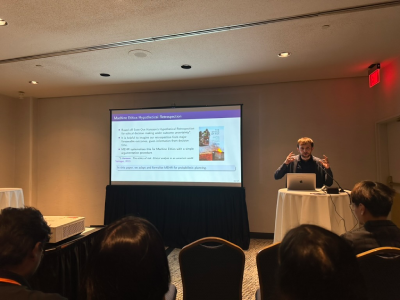
Machine Ethical Decisions with Hypothetical Retrospection (2023)
Simon Kolker, Louise Dennis, Ramon Fraga Pereira, and Mengwei Xu
UTILITARIAN
By remaining a bystander, you have not directly caused harm, though you may have allowed it to occur.
Philippa Foot's famous Trolley Problem illustrates how our moral intuitions may conflict. Subtle variations of the problem lead many to different judgments.
As we develop machines whose actions have moral consequences, we must consider the kind of morality they should follow.
What if the scenario isn't so simple? If the outcomes are uncertain or the decisions are sequential?